
The production of animations, whether marketing, advertising, video explainer or otherwise, looks very similar. The increasing popularity and potential of animations means that we are creating more and more of them. What are the stages of production? What can be done to make an animation effective?
Stages of animation production:
- Objective
First of all, it is necessary to define the purpose of the presentation. We will act differently with a product animation, differently with an advertising animation, and differently when the objective is a video explainer. It is very important that at the beginning we clearly define: why do we need this animation? This will determine each subsequent step..
- Concept and scenario
Once we have established the objective, we move on to the concept and script. At this stage, we determine how long the animation should last, choose the technique (2D or 3D) and will it be just picture , voiceover or maybe voiceover and additional subtitles? All this is important when writing the script and defining the overall concept for the animation. We have included these two activities in one point because they are created almost in parallel and are strongly dependent on each other. With the agreed duration of the animation and other initial guidelines in mind, we write the script. The script will be different depending on the objective. In a product animation, we will focus primarily on presenting the most important and greatest benefits of the product. In a viedo explainer, we will focus on clear communication, readability and explaining as much as possible..
- Graphic style
The next step is to show a proposal for the graphic style, the colour scheme, the look of the characters, the elements. All this gives the character of the animation. However, it must be in line with the brief, relevant to what we want to show and to whom..
- Storyboard
If we have all the visual guidelines selected and approved, the corresponding storyboard artist creates storyboards according to the script. All this is done to make animation easier and to have a preview of what the animation will look like. Admittedly, at this stage you have to use your imagination a lot to see how the animation will look in motion. However, with storyboards, we will already have at least a minimal preview of the whole. Animation is slowly coming to life!.
- We animate!
When it all comes together and the storyboards have confirmed that we have gone in the right direction there is no need to wait. We are animating! Depending on whether we have chosen 2D or 3D animation, its production will look different. After all, 2D is an image in two dimensions, and 3D requires modelling in 3D.
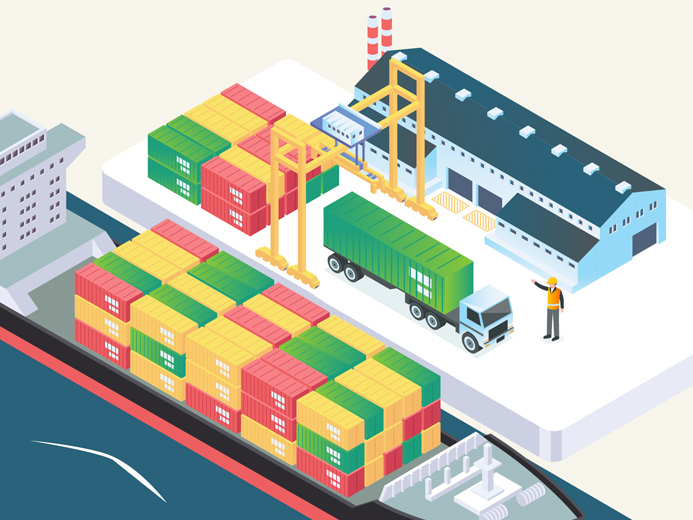
The video explainer we created for the e-Containers company is in 2D. A lector adequately to the animation image tells the story of the company and what it does. We adjusted the colours and graphic style to the graphics associated with the company.